2017年12月11日星期一

SIIC industrial filter bags applications-Aseptic Food Processing

SIIC offers the most advanced industrial filter bags in the world with features such as multi-layer constructions, pleated extended surfaces, fully-welded constructions and pressure-activated seals.
SIIC offers a range of industrial filter bags and bag filter housings to meet your liquid filtration and absolute filtration needs.(for more, please visit our website at www.filterworkshop.com)
Applications: Aseptic Food Processing

Recommended industrial filter bags: SIIC 1, 5 micron PE/PP felt filter bags

2017年12月7日星期四

100 vs 200 micron filter socks bags

100 vs 200 micron filter socks bags

Both 100 micron and 200 micron filter bags or socks are industrial filter bags for liquid filtration.

Available filter socks materials are needle punched felt-polyester (PE) and polypropylene (PP) felt, nomofaliment nylon mesh(NMO).
Available filter bags size include: size1# 7*17inch, size 2# 7*32inch, size3# 4*9inch, size4# 4*15inch, size5# 6*22inch and other customizable size.
Shanghai Indro Industry Co., Ltd is filter bags/socks supplier, who is making and supplying 1-5-25-50-75-100-150-200-250-300 micron rating filter bags and socks for industrial liquid filtration.(for more, please visit our website:www.filterworkshop.com)
Available filter bags/socks structure:
Welded bag body and plastic ring top
Stitched bag body and snap ring top
Stitched bag body and drawstring top
100 micron filter bags are made of 100 micron filter media, it can filter the particles in size larger than 100 micron.
200 micron filter socks are made of 200 micron filter media, it can filter the particles in size larger than 200 micron.
When same material, same size and same structure, 100 micron filter sock will be a little heavier than 200 micron filter socks, cost of 100 micron filter sock is also a little higher than 200 micron filter bags.


2017年11月27日星期一

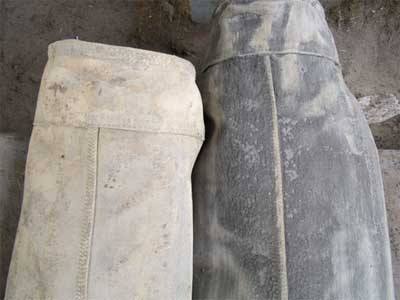
Why material blocking and paste bag of baghouse filter bags at the top of cement bunker?

Why material blocking and paste bag of baghouse filter bags at the top of cement bunker?
The reasons for material blocking and paste filter bags are as followings:

Because the baghouse dust collector at top of cement bunker only opens when feeding, the bag type dust collector at top cement bunker which has no feeding stock is in a state of discontinuation. But the material must go through the front storeroom to reach the designated repository to complete the storage. For example, when the cement material is to enter the No. 5 storeroom, it is necessary to be sent through air chute to pass through the 1~4 storeroom, then enter into No.5 storeroom, while the baghouse dust collector at the tops of the previous 4 tanks is stopped. The air transport chute should be driven by the inclined slot fan, and the positive pressure is generated in the chute. So there will be cement dust particles enter the above shell of the top bag dust collector inside the shell through dust removal duct connected to the air conveying chute.

A part of cement dusts are hanged on the outer surface of filter bags, and a part of dusts fall into ask bucket, and some will fall in the pipeline caused by accumulation. Because of the causes of production and sales, some cement banks do not feed for 1~2 month time, so the baghouse and dust collector on the top of these tanks will not open for a long time. Cement dust which fall into dust collector will be damped and coagulate, which cause dust remover filter bags paste, the air inlet pipe plugging, feed hopper caking.
When the bag dust collector open again, they cannot run normally, finally to make sure bag filters run normally, you will have to clean hopper and do replacement of filter bags.

When the cement storehouse is discharging, only the bag dust collector at the bottom of the material is opened, but the top of the library is not open, when the cement storeroom is discharged, positive pressure is generated in the storehouse. There will be cement dust particles coming into the dust collector shell through the dust collecting duct connected to the top of the storehouse, and this phenomenon (filter bags paste and material blocking) will happen after long time. Similarly, when feeding the storage bucket, lift the bag dust collector at the head wheel, because it is interlocked with the bucket elevator, no matter what the feed should be opened, the duster has never had a paste or block material for filter bags.

2017年11月24日星期五

Applications of high temperature resistant filter bags in 4 kinds of industry

Applications of high temperature resistant filter bags in 4 kinds of industry

Application in cement industry:
A lot of high temperature dust gas will be produced in every production link of cement enterprise, mill and plants.
The dust goes out with the exhaust gas. The waste gases in the cement industry which affect the atmosphere include dust, sulfur dioxide, nitrogen oxides, carbon dioxide, hydrofluoric acid and so on. The dust will cause pneumoconiosis, and acid gases will affect many kinds of plants and animals. At present, the main high-temperature resistant filter bags used in cement industry is fiberglass filter bags with ptfe membrane, aramid fiber filter bags, P84 filter bags.

Application in coal fired power plant:
Coal fired power plant is the focus of air pollution and regional acid deposition control, the main emissions are sulfur dioxide, nitrogen oxides and PM particles. Practice shows that the application of bag filter in coal-fired power plants is feasible and reliable. At present, the PPS high temperature dust collector filter bag or the PPS composite dust collector filter bag is widely used, because it is a kind of filter material with better comprehensive performance, such as excellent chemical stability, high temperature resistance, radiation resistance and good electrical insulation, etc.


Applications in iron and steel industry:
Sintering dust in iron and steel industry is very large, especially the coking sulfur oxides, nitrogen oxides and carbon hydride, Mo derivatives have large toxicity. Practice shows that the dry purification of iron and steel industry can significantly reduce environmental pollution, and also save energy, so the use of filter bag of high temperature dust collector is possible. But the high temperature dust filter bag requirements on the converter, blast furnace and sintering are not the same, so selecting dust filter bags should be considered according to the actual situation, for example, the sintering flue gas filter bag filter temperature requirement is 150 - 200 degrees. At present, glass fiber high temperature dust filter bags are mainly used, while the blast furnace and converter gas dust collector and baghouse filter bags need to withstand more than 300 degrees, such as ceramic fiber high temperature dust filter bag.

Application in waste incineration:
Municipal solid waste incineration is a high temperature thermo chemical treatment technology. In the incineration of tail gas, the main harmful substances are teratogenicity and carcinogenicity of dioxin and furan, these substances are formed in the process of combustion of chlorine and hydrocarbons, especially a large amount of plastic bags and boxes and other plastic products, easier to produce dioxins in incineration. The filter bags of high temperature dust collector baghouse widely used in this kind of flue gas is PPS, P84, glass fiber filter bags.

Applications of high temperature resistant filter bags in 4 kinds of industry:

In cement industry, coal fired power plant, iron and steel industry and waste incineration industry, fiberglass, nomex(aramid), pps, p84 dust collector and baghouse filter bags are widely used.

2017年11月22日星期三

How to cool the high temperature flue gas of pulse jet dust collector baghouse filter


As one professional manufacturer of pulse jet baghouse replacements, Shanghai Indro supplies filter bags, cages and pulse jet valves.
Generally, there are 3 kinds of method to cool high temperature gas in pulse jet bag filters as followings:

Water cooling: divided into two methods, one method is to spray water directly into the high temperature flue gas and cool down, which can be used as a special spay cooling tower, cooling tower cross-section wind speed is usually 2-3.5 M / sec, the temperature control system can be used to adjust the water quantity to prevent water mist from entering the pulse bag filter. Another method is to use cooling water pipe, installed in the pipeline transporting gas, can prevent the water into the pulse bag type dust remover and the corrosion problem, this method has strong cooling capacity and small space occupation, there may be water mist into the pulse jet bag filter, which possible take moisture and corrosion.

Natural cooling:
Lengthen the length of the pipeline carrying gas, and make the gas cool down by natural convection and radiation cooling effect between the pipe and the surrounding air. It can be used as an “s” type for long intervals. This method is simple, cooling is weak, and the space occupied is larger.

Cold air mixture:
Inhale a certain amount of air from the surroundings, which is to mix with high temperature flue gas to reduce the temperature. When catching traps to collect high temperature flue gas, the ambient air can be inhaled. Although this method is simple, the volume of filter gas is increased a lot.


Generally, there are 3 kinds of method to cool high temperature gas in pulse jet bag filters: water cooling, natural cooling, cold air mixture.

What is industrial dust collector and baghouse filter bag?

Dust collector and baghouse filter bags are the industrial filter sleeve or filter socks which are to fit dust collector/baghouse cages in dust collector/baghouse.
Baghouse filter bags are available in both high and low temperature options for pulse jet, shaker and reverse air dust collectors.
Shanghai Indro Industry Co., Ltd is one professional filter bags manufacturer and supplier. (www.filterworkshop.com)


A baghouse (BH, B/H), bag filter (BF) or fabric filter (FF) is an air pollution control device that removes particulates out of air or gas released from commercial processes or combustion for electricity generation. Power plants, steel mills, pharmaceutical producers, food manufacturers, chemical producers and other industrial companies often use baghouses to control emission of air pollutants. Baghouses came into widespread use in the late 1970s after the invention of high-temperature fabrics (for use in the filter media) capable of withstanding temperatures over 350 °F. Unlike electrostatic precipitators, where performance may vary significantly depending on process and electrical conditions, functioning baghouses typically have a particulate collection efficiency of 99% or better, even when particle size is very small.
Filter Bags types:
Baghouses are classified by the cleaning method used. The three most common types of baghouses are mechanical shakers, reverse gas, and pulse jet.
According to baghouse cleaning method, filter bags are divided into shaker filter bags, reversed air filter bags and pulse jet filter bags.
Fabric filter bags (sometimes referred to as envelopes) are oval or round tubes, typically 15–30 feet and 5 to 12 inches in diameter, made of woven or felted material. Depending on chemical and/or moisture content of the gas stream, its temperature, and other conditions, bags may be constructed out of cotton, nylon, polyester, fiberglass or other materials.
Nonwoven materials are either felted or membrane. Nonwoven materials are attached to a woven backing (scrim).Felted filters contain randomly placed fibers supported by a woven backing material (scrim). In a membrane filter, a thin, porous membrane is bound to the scrim. High energy cleaning techniques such as pulse jet require felted fabrics.
Woven filter materials have a definite repeated pattern. Low energy cleaning methods such as shaking or reverse air allow for woven filters. Various weaving patterns such as plain weave, twill weave, or sateen weave, increase or decrease the amount of space between individual fibers. The size of the space affects the strength and permeability of the fabric. A tighter weave corresponds with low permeability and, therefore, more efficient capture of fine particles.
 Reverse air filter bags have anti-collapse rings sewn into them to prevent pancaking when cleaning energy is applied. Pulse jet filter bags are supported by a metal cage, which keeps the fabric taut. To lengthen the life of filter bags, a thin layer of PTFE (teflon) membrane may be adhered to the filtering side of the fabric, keeping dust particles from becoming embedded in the filter media fibers.

Some baghouses use pleated cartridge filters, similar to what is found in home air filtration systems.

2017年11月20日星期一

Dust collector and baghouse filter bags materials for cement kiln

Using bag type or electric bag composite dust collector (including bag area of electric bag composite dust collector, which is called bag filter/dust collector bag house), is one of the main means to solve the discharge of flue dust in the kiln. The dust collector filter bag is the core component of bag filter, and its quality and performance determine the operation effect, service life and economy of bag filter. Therefore, it is the focus of cement production enterprises to compare the performance of various kinds of filter bag materials and select the filter bag with higher cost performance.

Because of the difference of cement production process, the difference of smoke and dust properties, the difference of operation management level, the use conditions of filter bag vary greatly, it is difficult to compare the performance of various filter bags in actual engineering. Therefore, Shanghai Indro Industry Co., Ltd chooses the four kinds of filter bags materials used in cement kiln to compare the performance and technology in laboratory. The purpose is to guide the users to choose the baghouse filter bags with higher cost performance, reduce the blindness and randomness of the selection, and meet the requirements of high filtration efficiency, low operation resistance, energy saving and long service life.
For this purpose, as one professional filter bag and materials manufacturer, SIIC(Shanghai Indro Industry) engineers select four kinds of materials to compare and test from the performance: such as woven fiberglass with ptfe membrane, fiberglass felt, P84 needle felt (PI) and SIIC special cement kiln filter material-composite filter felt.

1, woven glass fiber media/cloth with ptfe membrane
On the surface of glass fiber filter material, a microporous film is formed, and it is densely attached to the surface of glass fiber base material, so as to give full play to the role of the ptfe lamination, and improve the water resistance, oil resistance, corrosion resistance and air permeability of the filter material. Improve the performance of glass fiber filter material.
2, fiberglass needle felt filter material
It is belongs to the nonwovens, at present needle felt filter class are commonly used in the fabric on the basis of the fluffy and no fiber net strength by forming, and go through a complex process, the needle filter in fiber staggered three-dimensional structure, this structure is conducive to the formation of a dust layer, filtering and after cleaning does not exist through the gap, the filtering effect is stable.
3, P84 fiber filter material
P84 is the trade name, scientific name polyimide, abbreviated PI.
It is a high technology, organic polymer material. The P84 fiber cross section has three leaves and has very high fiber surface area coefficient. Compared with other fibers with different shapes, the fiber has the characteristics of large specific surface area, small porosity and large porosity. In addition, P84 fiber filter material can be used continuously under 260 degrees Celsius, the instantaneous temperature can reach 280 degrees, with high filtration efficiency, low running resistance, long service life.
4, SIIC special cement kiln filter material-composite filter felt
It is belongs to the nonwoven composite filter material, using high performance aramid fiber as the main raw material, filling a certain proportion of P84 fiber, PTFE filament fabric as the support structure, absorbing the "three-dimensional asymmetric structure" and "micro hole" design, the filter material can be comparable with the 100% P84 filter material, has the advantages of high efficiency, low resistance, long life.

Dust collector and baghouse filter bags materials for cement kiln:

To help the users to choose the baghouse filter bags with higher cost performance, SIIC engineer chooses the four kinds of filter bags materials used in cement kiln to compare the performance: woven fiberglass with ptfe membrane, fiberglass felt, P84 needle felt (PI) and SIIC special cement kiln filter material-composite filter felt.